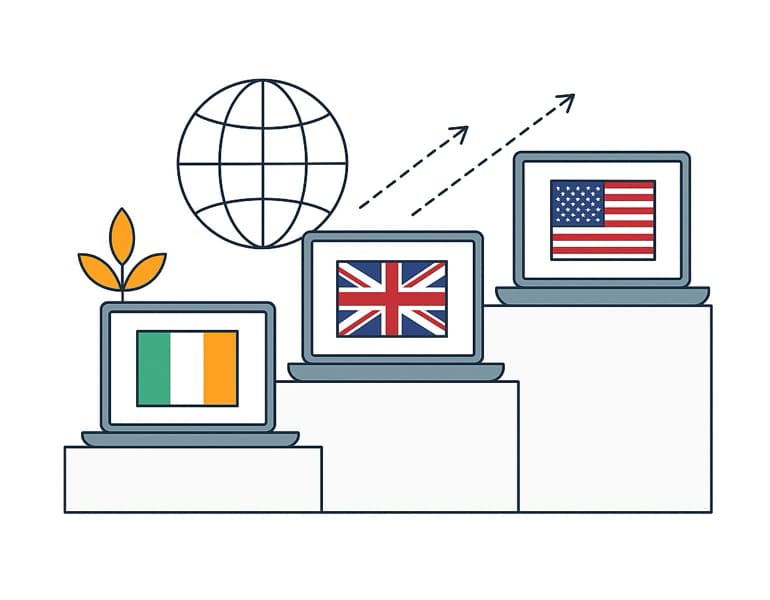
The digital marketplace has transformed how businesses compete, creating both unprecedented opportunities and formidable challenges for Irish companies. Whilst geographic barriers have diminished in the online world, Irish businesses often find themselves competing against UK and US counterparts with deeper pockets, established brand recognition, and substantial resources. However, being smaller or lesser-known doesn’t mean being disadvantaged. Irish businesses possess unique strengths that, when leveraged strategically, can level the playing field and even provide competitive advantages in the global digital arena.
The key to success lies not in attempting to outspend larger competitors, but in outsmarting them through strategic positioning, authentic storytelling, and tactical excellence. This article explores practical, actionable strategies that Irish businesses can implement to compete effectively online against their UK and US rivals, turning perceived limitations into distinctive advantages.
Understanding Your Competitive Landscape
Before implementing any competitive strategy, Irish businesses must conduct thorough competitive analysis. This means understanding not just who your competitors are, but how they operate online, what value propositions they offer, and where gaps exist in their approach.
UK and US competitors often operate with certain assumptions about their market dominance. They may rely heavily on brand recognition, assume their larger budgets guarantee visibility, or overlook niche segments they consider too small. These assumptions create opportunities for agile Irish businesses to identify underserved markets, unaddressed customer needs, and positioning angles that larger competitors have ignored.
Research your competitors’ digital presence comprehensively. Examine their websites, social media engagement, content strategies, customer reviews, and search engine rankings. Tools such as SEMrush, Ahrefs, or even free alternatives like Google Alerts can provide valuable intelligence about competitor activities, keyword strategies, and content performance. Understanding where they excel—and more importantly, where they fall short—enables you to craft strategies that exploit these weaknesses whilst capitalising on your strengths.
Leveraging Your Irish Identity as a Unique Value Proposition
One of your most powerful competitive advantages is something your UK and US competitors cannot replicate: your authentic Irish identity. In an increasingly globalised marketplace, consumers actively seek genuine, distinctive brands with compelling origin stories. Ireland’s international reputation for creativity, authenticity, quality craftsmanship, and rich cultural heritage provides a strong foundation for brand differentiation.
Integrate your Irish heritage into your brand narrative without resorting to clichés or stereotypes. Share the genuine story of your business—the people behind it, the Irish community you serve, the local suppliers you work with, or how Irish values shape your business practices. This authenticity resonates powerfully with both Irish consumers seeking to support local businesses and international customers attracted to genuine Irish products and services.
Companies like Kerrygold have demonstrated how effectively Irish provenance can be marketed internationally, turning geographic origin into a premium brand attribute. Whether you’re selling software, professional services, artisan products, or digital solutions, your Irish roots can differentiate you in crowded markets where UK and US brands often appear interchangeable.
Dominating Local and Niche Search Results
Whilst competing for broad, highly competitive search terms against large UK or US competitors requires substantial resources, Irish businesses can achieve remarkable visibility by focusing on local and niche search optimisation. This targeted approach delivers higher-quality traffic and better conversion rates than competing for generic terms.
Optimise rigorously for local search by ensuring your Google Business Profile is complete, accurate, and regularly updated with posts, offers, and customer interactions. Incorporate Irish location terms naturally throughout your website content—not just Dublin, Cork, or Galway, but specific neighbourhoods, regions, and landmarks that potential customers actually search for.
Create location-specific content that addresses uniquely Irish concerns, regulations, preferences, or cultural considerations that UK and US competitors overlook. For instance, content about navigating Irish regulations, serving Irish market needs, or understanding Irish consumer preferences positions you as the specialist whilst larger competitors appear generic and disconnected.
Niche specialisation offers another powerful avenue for competing against larger rivals. Rather than offering everything to everyone, identify specific market segments, industry verticals, or customer problems where you can develop genuine expertise and authority. Deep specialisation allows you to dominate search results within your niche, build stronger customer relationships, and command premium pricing—advantages that offset the scale benefits of larger competitors.
Creating Superior, Customer-Focused Content
Content marketing levels the playing field between businesses of vastly different sizes. A well-researched, genuinely helpful article can outrank content from much larger competitors if it better serves user intent and provides superior value.
Develop a content strategy that addresses the specific questions, concerns, and needs of your target audience. Rather than producing generic content, create resources that reflect deep understanding of your customers’ challenges. This might include detailed how-to guides, industry-specific insights, case studies demonstrating Irish solutions to Irish problems, or thought leadership that showcases your expertise.
Quality consistently trumps quantity in content marketing. One comprehensive, expertly crafted resource that thoroughly addresses user needs will generate more traffic, engagement, and conversions than numerous superficial articles. Irish businesses, with their often closer relationships to customers, can leverage these insights to create remarkably targeted, relevant content that larger competitors’ content teams cannot match.
Consider formats beyond traditional blog posts. Video content, podcasts, infographics, and interactive tools can differentiate your content strategy whilst serving customers who prefer alternative formats. These varied approaches also create multiple pathways for search visibility and social sharing.
Building Genuine Community and Customer Relationships
Scale can be both an advantage and a liability. Whilst UK and US competitors may have larger customer bases, they often struggle to maintain personal relationships and responsive service. Irish businesses can compete by excelling precisely where larger competitors are weakest: building genuine community and maintaining authentic customer relationships.
Engage actively and personally on social media platforms where your audience congregates. Rather than broadcasting corporate messages, participate in conversations, respond promptly to queries, acknowledge feedback, and demonstrate the human faces behind your business. This personalised approach builds loyalty that transcends price competition and creates advocates who actively recommend your business.
Implement customer service excellence as a competitive differentiator. Respond to enquiries within hours rather than days, provide knowledgeable assistance rather than scripted responses, and empower your team to solve problems creatively. These practices, increasingly rare among large corporations focused on efficiency metrics, create memorable experiences that generate positive reviews, referrals, and repeat business.
Create platforms for community building around your brand. This might include customer forums, social media groups, local events, webinars, or user groups where your customers can connect with each other and your team. These communities generate valuable feedback, create emotional investment in your success, and raise switching costs for customers considering competitors.
Embracing Agility and Innovation
Smaller size, often perceived as a disadvantage, actually enables responsiveness and innovation that large competitors cannot match. Established UK and US businesses typically operate with bureaucratic decision-making processes, legacy systems, and institutional resistance to change. Irish businesses can exploit this competitive weakness through strategic agility.
Monitor market trends, customer feedback, and competitor activities continuously, then adapt quickly. If customer needs shift, adjust your offerings promptly. If new technologies emerge, evaluate and implement them before competitors recognise their potential. If market opportunities appear, pivot resources to capitalise whilst larger competitors remain committed to outdated strategies.
Experiment boldly with new marketing channels, technologies, and approaches. Test emerging platforms before they become saturated with competitors. Trial innovative pricing models, service delivery methods, or customer experience enhancements. Some experiments will fail, but successful innovations can provide substantial competitive advantages before larger competitors replicate them.
This agility extends to crisis response and reputation management. When issues arise, smaller businesses can investigate, respond, and resolve problems far more quickly than corporate competitors navigating approval hierarchies and legal reviews. This responsiveness protects reputation and demonstrates customer commitment in ways that larger competitors simply cannot match.
Strategic Partnerships and Collaboration
Competition doesn’t preclude collaboration. Irish businesses can amplify their competitive position through strategic partnerships that provide capabilities, reach, or resources that would be difficult to develop independently.
Seek complementary businesses serving similar target markets with non-competing offerings. Joint marketing initiatives, bundled services, or reciprocal referrals extend your reach and credibility whilst sharing costs. These partnerships are particularly valuable when they connect you with partners who already have established customer relationships you wish to access.
Consider industry associations, business networks, and enterprise support organisations throughout Ireland. These connections provide not just networking opportunities but also collective bargaining power, shared resources, and credibility enhancement that helps smaller businesses compete more effectively.
Collaborate with Irish influencers, content creators, or micro-influencers within your industry. These partnerships often prove more cost-effective and authentic than traditional advertising whilst providing access to engaged audiences that trust the influencer’s recommendations.
Optimising Conversion Rather Than Just Traffic
UK and US competitors often focus heavily on driving traffic volume, sometimes neglecting conversion optimisation. Irish businesses with smaller marketing budgets should prioritise conversion excellence, ensuring that the traffic you attract converts at superior rates.
Implement rigorous conversion rate optimisation practices. Analyse user behaviour through tools like Google Analytics and Hotjar to understand where visitors struggle, abandon, or disengage. Test different headlines, calls-to-action, page layouts, and checkout processes to systematically improve conversion rates. Even modest improvements—converting 3% of visitors rather than 2%—deliver substantial business impact without requiring additional traffic.
Develop clear, compelling value propositions that immediately communicate why customers should choose you over alternatives. This clarity becomes especially important when competing against recognised brands; visitors must instantly grasp the specific benefits you offer.
Reduce friction throughout the customer journey. Simplify navigation, minimise form fields, provide multiple payment options, ensure mobile optimisation, and eliminate unnecessary steps between initial interest and completed purchase. Each friction point removed improves conversion rates and competitive positioning.
Conclusion
Competing online against established UK and US competitors presents genuine challenges for Irish businesses, but these challenges are far from insurmountable. Success requires strategic thinking that emphasises distinctive advantages rather than attempting to match competitors’ resources.
Your Irish identity, when authentically expressed, differentiates your brand in homogenised markets. Your specialised focus delivers relevance that generalist competitors cannot match. Your agility enables innovation and responsiveness that bureaucratic organisations struggle to replicate. Your commitment to customer relationships builds loyalty that transcends price competition.
The digital marketplace rewards not just financial resources but creativity, authenticity, strategic focus, and customer commitment—areas where Irish businesses can excel regardless of size. By implementing these strategies systematically, Irish businesses can not only compete effectively but often outperform larger UK and US rivals, building sustainable competitive advantages in the global digital economy.
The question isn’t whether Irish businesses can compete online against larger international competitors—it’s whether they’re willing to compete strategically, leveraging their unique strengths rather than merely attempting to outspend opponents with deeper pockets. Those who embrace this strategic approach will discover that being Irish isn’t a competitive disadvantage—it’s a distinctive advantage waiting to be leveraged.