Ireland’s digital landscape has transformed rapidly in recent years, with online shopping adoption reaching 85% in 2024 and expected to hit 100% of the 16–74 population by 2025. Consumer expectations have evolved just as quickly: Irish shoppers demand fast, seamless, mobile-friendly experiences, and the value of online sales continues to climb, with digital commerce forecast to surpass €16 billion in 2024. Ireland now ranks among Europe’s top nations for online purchasing, with 96% of internet users buying online, a statistic that underscores how essential strong digital performance has become for every business.
Despite this shift, many Irish SMEs still operate websites that undermine their competitiveness. Slow page speeds, outdated layouts, incomplete local SEO, and a lack of trust-building elements all contribute to high bounce rates and weak visibility on Google.ie. In a market where remote work, mobile usage, and “near me” searches dominate behaviour, these shortcomings translate directly into missed revenue opportunities.
This analysis explores the top critical website mistakes hurting Irish businesses, combining practical recommendations with local context—from rural connectivity limitations to changing post-COVID consumer habits. The goal is simple: to help you turn your website into a modern, credible, conversion-driven platform aligned with Ireland’s increasingly digital, decentralised, and fast-moving economy.
Slow Loading Speeds
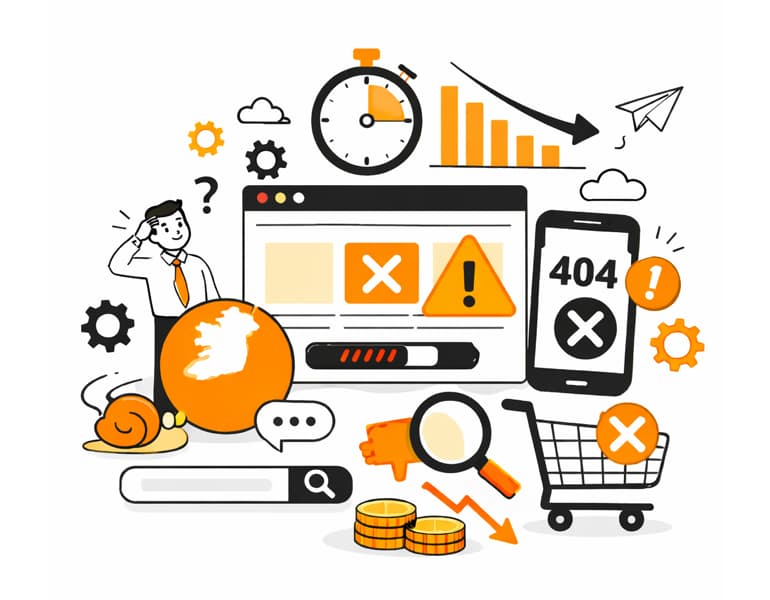
Slow loading times remain one of the most damaging issues for Irish websites, especially in a market where mobile usage dominates and rural broadband speeds vary widely. When a site takes longer than three seconds to load, users abandon it—contributing to bounce rates that can reach over 50%, particularly on mobile. Unoptimised images, bloated plugins, heavy themes, and low-quality hosting all add unnecessary weight, leading to poor Core Web Vitals scores and reduced visibility on Google.ie.
These performance issues are even more pronounced on 4G-dependent areas across counties like Kerry, Mayo, and Donegal, where slower connections magnify every inefficiency. Many SMEs also rely on shared hosting environments that buckle under peak traffic, causing significant slowdowns during business-critical hours.
To fix this, prioritise a lean, efficient website structure.
Poor Mobile Responsiveness
With over 60% of Irish website traffic coming from mobile devices, a site that doesn’t adapt seamlessly to varying screen sizes is guaranteed to lose visitors. Many Irish SMEs still use fixed-width designs, tiny text, or layouts that break on iOS and Android, creating a frustrating experience that leads users to abandon the page within seconds. Beyond usability issues, non-responsive sites perform terribly under Google’s mobile-first indexing, making them nearly invisible for high-intent local queries such as “plumber near me Cork” or “hairdresser in Limerick”.
Pinch-to-zoom layouts, horizontal scrolling, and cramped navigation immediately signal an outdated site—an impression Irish users no longer tolerate, especially in an era where mobile shopping and service bookings keep rising. A failing score in Google’s Mobile-Friendly Test is effectively a warning that your site is leaking leads and sales.
A mobile-responsive website isn’t optional, it’s the foundation for ranking well, capturing local searches, and converting Ireland’s increasingly mobile-first audience.
Ignoring Local SEO
A business without a fully optimised Google Business Profile is virtually invisible in local searches, missing out on map pack placements for queries like “Dublin plumber” or “Cork electrician.” Inconsistent or outdated name, address, and phone (NAP) listings across directories such as Golden Pages can further erode local authority and trust.
Optimising your profile with accurate details, professional photos, and prompt review responses can drive significant local traffic—studies show reviews alone can increase visits by up to 30%. Enhancing your site with schema markup and creating county-specific landing pages boosts local relevance, making it easier for Irish customers to find, engage with, and trust your business.
Weak Calls-to-Action
Vague, generic prompts like “Click Here” offer no direction and cause visitors to leave without booking or purchasing, an especially costly mistake in Ireland’s action oriented sales environment. When CTAs are missing above the fold, businesses lose the chance to convert up to 70% of visitors, a major setback for SMEs relying on seasonal surges such as Black Friday and Christmas.
Effective CTAs speak directly to user intent. Replace bland buttons with value-driven commands like “Get Your Free Dublin SEO Audit” or “Book a Consultation in Cork Today.” Use strong colour contrast, such as orange against a blue background, to ensure instant visibility.
Inadequate SEO Basics
Ignoring essential SEO elements—such as meta titles, descriptions, image alt tags, and proper header structure—quickly pushes a site off the first page of Google.ie. Keyword stuffing or publishing generic content also hurts rankings, especially when competitors target local search terms like “web design Dublin” or “SEO agency Galway.”
Ireland’s growing use of voice search makes conversational, long-tail keywords such as “affordable SEO agency near Dublin” increasingly valuable. Using a .ie domain, adding schema markup, and ensuring each page has a unique H1 strengthens both relevance and visibility. Tools like SEMrush and Ahrefs can help identify gaps and monitor backlink quality.
High-quality links from reputable Irish blogs or industry sites still carry weight, and regularly disavowing toxic links prevents future ranking issues.
Cluttered Navigation
Overloaded menus confuse visitors and make it harder for them to find essential information like pricing or contact details. Without breadcrumbs or a clear hierarchy, users become stuck in deeper pages, which increases exit rates and leaves search engines struggling to crawl the site effectively.
A simple structure (Home, Services, About, Blog, Contact) provides clarity. Mega-menus can be used for more detailed service breakdowns, such as “SEO Packages – Dublin / Cork.” Proper H1–H3 hierarchy improves readability and helps Google understand your content.
Heatmaps from tools like Hotjar often highlight confusing paths. Irish users respond well to navigation that includes local distinctions, like “Irish Hosting vs UK Hosting,” which can help reduce bounce rates.
Security Oversights
Websites without SSL certificates or regular updates appear unsafe and are more vulnerable to attacks—especially risky in Ireland’s FDI-heavy environment, where data protection standards are closely scrutinised. Outdated plugins or nulled themes can expose entire sites to breaches.
Installing free SSL with Let’s Encrypt, enabling firewalls, and scanning regularly with tools like Sucuri significantly reduce risk. Weekly updates to WordPress core, themes, and plugins prevent most vulnerabilities. Two-factor authentication adds another layer of protection.
Remember, preventative security is always cheaper than a breach, both financially and reputationally.
Missing Trust Signals
A lack of visible trust signals makes users hesitant, particularly since Irish consumers increasingly verify whether a business is legitimate and Irish-owned before purchasing. Missing SSL certificates, absent VAT details, or no testimonials can quickly push potential buyers away.
Displaying reviews, client logos, and trust badges (such as Trustpilot or payment security icons) immediately builds confidence. Adding review schema helps boost click-through rates on Google. Authentic testimonials—ideally with names and photos—carry far more weight than generic praise.
Live chat tools like Tidio help answer questions instantly, often improving conversion rates. Listing a physical address, such as a Dublin or Cork location, further strengthens trust.
Neglected Content Quality
Thin, unedited, or duplicate content makes a site feel low-effort and harms rankings. Pages under 300 words often struggle to rank, and copied text risks Google penalties. Many Irish businesses also miss opportunities to reference relevant local themes like remote work trends or Ireland’s FDI-driven tech sector.
Long-form content (1,500 words or more) supported by stats, visuals, and step-by-step guidance tends to rank best. Infographics and embedded videos increase engagement and social sharing. Updating content every few months signals freshness to search engines.
Many companies benefit from professional copywriting, ensuring tone consistency and clarity. A Belfast agency saw major ranking improvements after publishing original Irish-focused guides.
No Analytics Tracking
Without analytics, businesses lose insight into how people find and interact with their site. Missing GA4 data means no visibility into device types, referral sources, or high-exit pages, which limits informed decision-making.
Set up form-submission goals and connect Google Search Console to monitor impressions and ranking changes. Monthly reporting highlights which pages need improvement, whether due to high bounce rates or low engagement. Seasonal spikes, such as Ireland’s busy November shopping period, require early preparation.
Heatmaps from Crazy Egg reveal how far users scroll and where they drop off, enabling targeted improvements for different counties or regions.
Infrequent Updates
Websites that haven’t been updated since 2020 or earlier appear abandoned, and search engines tend to deprioritise them. Regular updates signal activity and relevance, especially as search behaviour shifts with trends like voice queries and remote work.
Posting new articles every two weeks is a strong benchmark. Covering topics like Ireland’s eCommerce growth, digital transformation, or local industry insights builds authority. Internal linking strengthens site structure and increases time on page.
Poor Image Optimisation
Large, uncompressed images slow down pages and harm both accessibility and SEO. Generic filenames like “photo1.jpg” and missing alt text waste opportunities to reinforce relevance.
Resize images to a maximum width of 1920px, save them in WebP format, and use descriptive filenames like irish-seo-mistakes-2025.jpg. Adding concise alt text improves accessibility and supports rankings. Lazy loading ensures visual elements only load when needed.
Ineffective Contact Pages
If users struggle to find your contact details, inquiries drop instantly. Hard-to-locate forms, no map directions, or generic emails can undermine credibility and frustrate mobile visitors.
Prominent, user-friendly layouts work best. Include Calendly for easy scheduling, WhatsApp for quick replies, and an embedded Google Map for clarity. Offering live chat during evening hours captures leads from users browsing after work.
Outdated Branding
Outdated visuals, including pixelated logos, mismatched colours, and old-fashioned fonts, make a website feel unprofessional, which is especially problematic in Ireland’s growing tech-driven market. Design elements that once looked modern can age quickly, weakening brand credibility.
Refreshing your visual identity once a year helps maintain professionalism. Clean, readable sans-serif fonts like Roboto pair well with modern layouts, and colour palette tools like Coolors ensure consistency across the site. Also, extending branding to elements like favicons and email signatures strengthens recognition.
Conclusion
A website is no longer just a digital presence—it’s a key driver of growth, trust, and visibility in Ireland’s competitive online market. Common mistakes like slow speeds, poor mobile design, and weak SEO can cost traffic and sales, but they are entirely fixable.
By prioritising website speed, responsiveness, strong calls-to-action, and localised, high-quality content, Irish businesses can transform their sites into powerful, revenue-generating assets. Regular audits and data-driven improvements ensure your website keeps pace with evolving trends, giving you a clear advantage in Ireland’s digital-first economy.